

















































SAP Business Data Cloud Foundation: Architecture Patterns & Best Practices
WRITTEN BY
Incture
Modern enterprises need more than a centralized data platform to turn data into business value. They need a trusted, governed, and reusable data foundation that preserves business context across SAP and non-SAP systems and supports analytics, planning, applications, and AI.
This is where SAP Business Data Cloud (SAP BDC) can play a foundational role. SAP Business Data Cloud brings together SAP and third-party data within a business data fabric architecture, helping organizations connect data with the business semantics, processes, and policies that give it meaning. SAP Datasphere serves as a key component for data integration, semantic modelling, data products, and governed data access.
However, implementing SAP BDC successfully is not simply a matter of moving data to the cloud. Organizations need the right architecture patterns, governance model, integration strategy, and reusable data assets to create a scalable and future-ready data foundation.
This article explores five SAP Business Data Cloud foundation patterns and best practices that can help enterprises build a data architecture designed for trusted analytics, data products, and AI-ready business data.

What Is an SAP Business Data Cloud Data Foundation?
A strong foundation typically combines:
- Business data products for reusable, governed data
- Semantic and analytical models for consistent business definitions
- Data integration and federation for connecting data across landscapes
- Zero-copy data sharing where appropriate
- Data governance and lineage for trust and compliance
- Domain-based ownership for accountability
- Knowledge graphs and connected context for advanced analytics and AI
- Reusable business models and KPIs for consistent decision-making
SAP Business Data Cloud supports multiple integration patterns, including batch processing, replication, real-time streaming, and federation, allowing organizations to choose the appropriate approach based on workload, performance, governance, and cost requirements.
The objective is not to move every piece of data into one location. It is to make trusted business data accessible, understandable, governed, and reusable wherever it is needed.
1. Shift from Data Projects to Data Products
Many organizations still approach data as a collection of individual projects. A business team requests a dashboard, another team builds a report, and a third team creates a dataset for an AI use case.
Over time, this project-based approach can create duplicate datasets, inconsistent business definitions, and significant maintenance effort.
A better approach is to treat data as a product.
A data product is a reusable, governed data asset designed for consumption by multiple users, applications, analytics workloads, or AI use cases. Within SAP Business Data Cloud, SAP-managed data products provide standardized, preconfigured datasets that can be consumed across SAP platforms and integrated with services such as SAP Datasphere, SAP Databricks, and SAP HANA Cloud.
SAP BDC data product best practices
- Organize data products around business domains such as Finance, Supply Chain, Procurement, Manufacturing, Sales, and Customer.
- Assign clear ownership and accountability to each data product.
- Define data quality, security, and lifecycle standards.
- Include business definitions, metadata, and documentation.
- Design data products for reuse across reporting, planning, analytics, and AI.
- Establish versioning and change-management processes.
- Make approved data products easy to discover through governed catalogues.
A data product approach can help organizations:
- Reduce duplicate data development
- Improve consistency across business functions
- Accelerate analytics and AI initiatives
- Increase trust in enterprise data
- Improve collaboration between business and IT
- Scale data consumption across domains
Foundation pattern:
Source systems → Governed data products → Semantic models → Analytics / Applications / AI
The goal is to move from building one dataset for one requirement to creating reusable business-ready data assets.
2. Prioritize Data Access Before Data Movement
One of the most important SAP Business Data Cloud architecture principles is to avoid moving data simply because the technology makes replication possible.
Every additional data copy introduces potential storage costs, synchronization requirements, security considerations, and governance overhead.
Instead, organizations should first ask:
Does this workload require a copy of the data, or can it access the data where it already resides?
SAP Business Data Cloud supports different data access and integration patterns, including federation, replication, batch processing, and real-time streaming. SAP also supports bidirectional, zero-copy data sharing across its open data ecosystem.
SAP BDC data movement best practices
Before replicating data:
- Evaluate federation or virtual access options.
- Determine whether the workload requires persistent storage.
- Replicate data when performance, historical retention, transformation, or workload isolation requires it.
- Consider zero-copy sharing where supported and appropriate.
- Review existing data copies for redundancy.
- Establish architecture standards for when data should be moved, replicated, or federated.
When should data be replicated?
Replication may be appropriate when:
- Query performance requires local data
- Historical data needs to be retained
- Complex transformations are required
- A workload requires isolated processing
- Source-system load must be reduced
- A downstream application requires persistent data
The principle is simple:
Move data when there is a clear business or technical reason. Otherwise, prioritize governed access to the data where it resides. This approach can reduce unnecessary duplication while improving data freshness and simplifying the overall data landscape.
3. Embed Governance and Security from Day One
A scalable data foundation cannot rely on governance as a post-implementation activity.
As data products, integrations, analytics models, and AI use cases multiply, organizations need governance embedded directly into the architecture.
SAP Business Data Cloud supports governed data access, catalogues, metadata, lineage, data products, and domain-based ownership as part of its business data fabric approach.
SAP BDC governance best practices
Establish governance across:
Ownership
- Define business and technical owners for critical data assets.
- Establish accountability at the domain level.
Security
- Implement role-based access controls.
- Apply appropriate authorization policies to sensitive data.
- Separate responsibilities across data producers and consumers.
Metadata
- Maintain business definitions and technical metadata.
- Use catalog to improve data discovery.
- Document data products and their intended use.
Data quality
- Define quality rules for critical business data.
- Establish monitoring and remediation processes.
- Track quality issues to their source.
Lineage
- Understand where data originates. Understand where data originates.
- Track transformations and downstream consumption.
- Make impact analysis easier when business logic changes.
Compliance
- Define retention and access policies.
- Apply regulatory and organizational requirements consistently.
Why governance is critical for AI
AI systems are only as reliable as the data and business context available to them.
SAP positions SAP Business Data Cloud as a foundation for trusted AI by connecting data with business context, semantics, and governance. Its business data fabric approach also includes connected context through knowledge graphs.
Therefore, governance should not be viewed only as a compliance requirement. It is an enabler for trusted analytics and AI.
4. Standardize Business Semantics, Models, and KPIs
Technology alone cannot create consistent reporting.
Two teams can access the same source data and still produce different results if they use different definitions for:
- Revenue
- Customer
- Product
- Supplier
- Order
- Inventory
- Employee
- Gross margin
- On-time delivery
This is why business semantics and reusable models are an important part of an SAP BDC data foundation.
SAP Datasphere provides semantic and analytical modelling capabilities that help organizations define measures, hierarchies, and business meaning consistently across workloads.
Best practices for semantic modelling
- Define common enterprise dimensions such as Customer, Product, Supplier, Employee, and Location.
- Establish standardized KPI definitions.
- Create reusable analytical and semantic models.
- Maintain a central business glossary.
- Document business rules behind critical metrics.
- Establish governance for changes to business logic.
- Reuse approved models instead of rebuilding calculations for individual reports.
From data consistency to business consistency
A mature data foundation should provide more than a single version of the data.
It should provide a consistent understanding of the business.
For example, if “Customer” has different definitions across CRM, ERP, finance, and analytics systems, simply integrating the systems will not solve the problem.
The architecture must also establish how those entities relate, which definitions are authoritative, and how they should be used across business processes.
This shared semantic layer becomes particularly important as organizations build AI applications and agents that need reliable business context.
5. Design for an Integrated Enterprise Data Ecosystem
Enterprise data rarely exists in one technology platform.
A typical landscape can include:
- SAP S/4HANA
- SAP Business Warehouse
- SAP Datasphere
- SAP Business Data Cloud
- SAP HANA Cloud
- SAP Analytics Cloud
- SAP Databricks
- Data lakes and lake houses
- CRM and customer platforms
- External applications
- Partner and industry data
An effective SAP BDC architecture therefore needs to support interoperability rather than isolation.
SAP Business Data Cloud supports multiple integration patterns across hybrid and cloud landscapes, including batch, replication, real-time streaming, federation, and zero-copy data sharing.
SAP BDC integration best practices
- Define standardized integration patterns.
- Choose integration methods based on workload requirements rather than platform preference.
- Support both batch and real-time use cases.
- Establish common monitoring and operational processes.
- Standardize logging and error handling.
- Secure data exchange across platforms.
- Design for future data sources and workloads.
- Minimize point-to-point integrations where reusable patterns are possible.
- Consider zero-copy data sharing where appropriate.
A practical decision framework
When designing an integration, consider these questions:
- Does the workload require real-time data?
If yes, evaluate real-time or event-driven patterns. - Is historical data required locally?
If yes, replication or persistent storage may be appropriate. - Can the workload operate on data in its current location?
If yes, consider federation or zero-copy access. - Does the data need transformation or harmonization?
If yes, determine where the transformation should occur. - Will multiple consumers need the same data?
If yes, consider creating a governed data product rather than a one-off dataset.
This approach makes integration decisions repeatable and helps prevent unnecessary architectural complexity.
6. Connect Data with Business Context for AI
A modern data foundation increasingly needs to support more than dashboards and traditional analytics.
Organizations are building predictive models, machine learning applications, generative AI solutions, and AI agents that need access to trusted enterprise data.
This changes the requirements for a data architecture.
AI needs more than raw data. It needs context, semantics, relationships, governance, and business rules.
SAP Business Data Cloud connects data with business processes, policies, and semantics through its business data fabric architecture. SAP also highlights knowledge graphs as a way to capture relationships across business data, processes, and entities for contextual understanding.
Best practices for an AI-ready data foundation
- Build governed data products rather than isolated AI datasets.
- Preserve business semantics throughout the data lifecycle.
- Establish consistent definitions for critical business entities.
- Track lineage and data quality.
- Connect related business entities and processes.
- Apply appropriate access controls to AI workloads.
- Reuse trusted models across analytics and AI initiatives.
The objective is to create a foundation where AI applications can access trusted data with business meaning, rather than requiring every AI project to rebuild context independently.
Common SAP Business Data Cloud Architecture Pitfalls to Avoid
Even well-designed data programs can encounter challenges when architecture decisions are made in isolation.
Avoid these common pitfalls:
- Treating governance as a separate workstream
Governance should be embedded into data products, models, access controls, metadata, and operating processes.
- Replicating data by default
Not every workload requires another physical copy. Evaluate federation, zero-copy sharing, and other access patterns first.
- Creating one dataset for every report
Reusable data products and semantic models can reduce duplication and accelerate new use cases.
- Allowing teams to define KPIs independently
Standardized business definitions are essential for consistent reporting and AI.
- Building point-to-point integrations
Reusable integration patterns reduce long-term complexity as the enterprise landscape grows.
- Focusing only on technology
A successful data foundation also requires ownership models, governance processes, operating models, and adoption strategies.
- Building AI without a trusted data foundation
AI initiatives can struggle when data quality, semantics, lineage, and business context are inconsistent.

SAP Business Data Cloud Foundation Architecture: A Practical Pattern
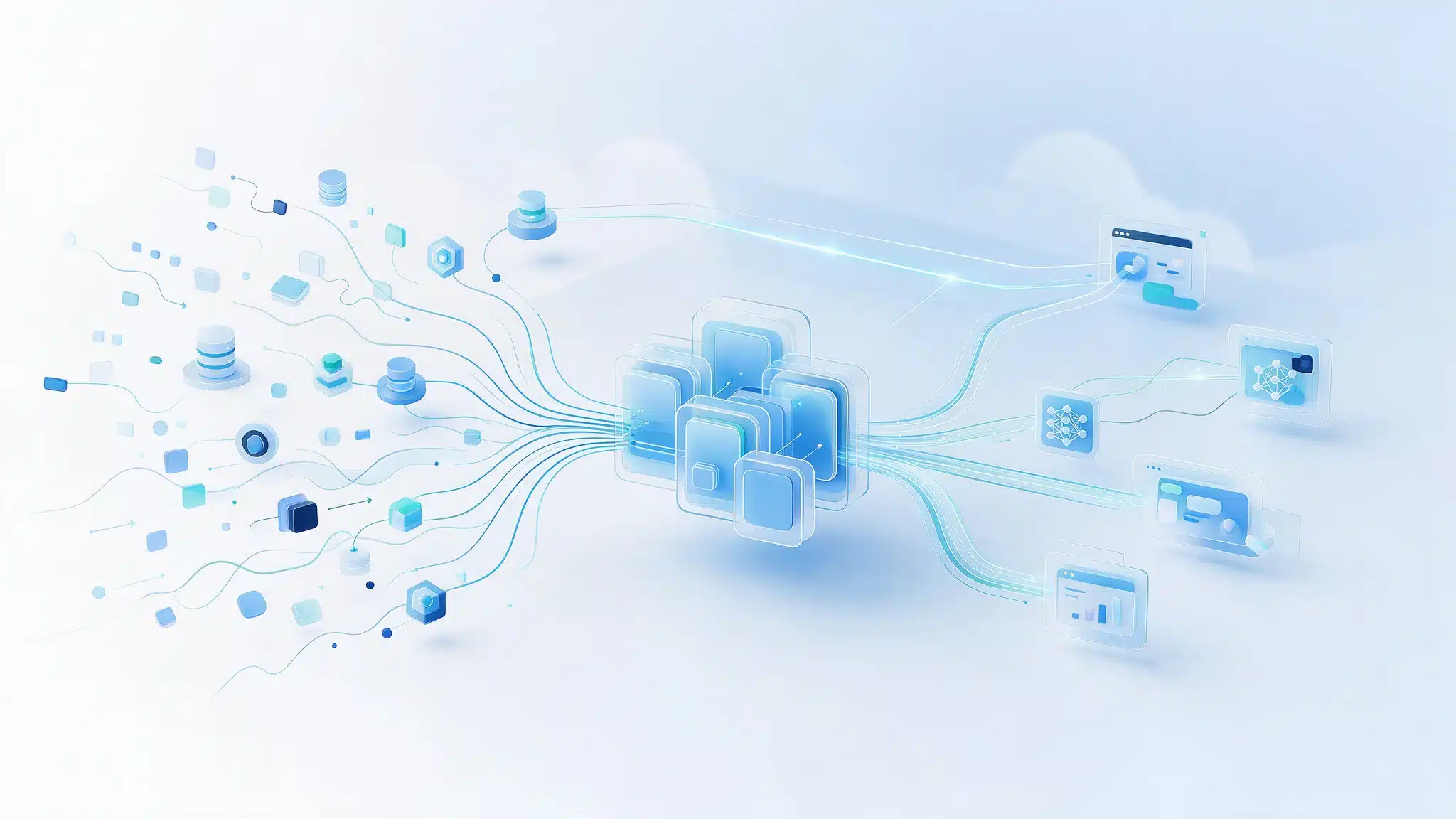
A future-ready SAP BDC architecture can be thought of as a series of interconnected layers:
Enterprise Data Sources
SAP applications + SAP BW + third-party systems + external data
↓
Integration & Data Access
Federation + replication + batch + streaming + zero-copy sharing
↓
Governed Data Foundation
SAP Business Data Cloud + SAP Datasphere + catalogs + metadata + lineage + governance
↓
Business Data Products
Reusable, domain-oriented, documented, governed data assets
↓
Semantic & Analytical Models
Common dimensions + KPIs + business rules + relationships
↓
Consumption Layer
Analytics + planning + applications + data science + AI/ML + AI agents
This architecture enables organizations to choose the right data access and processing pattern for each use case while maintaining governance and business context across the landscape.
SAP Business Data Cloud Foundation Best Practices: Quick Checklist
Before scaling an SAP BDC implementation, organizations should be able to answer “yes” to the following questions:
- Does every critical data product have a defined owner?
- Are business definitions and KPIs standardized?
- Is data governance embedded into the architecture?
- Are metadata and lineage available for critical data?
- Is data replicated only when there is a clear requirement?
- Are federation and zero-copy options evaluated where appropriate?
- Are integration patterns standardized?
- Can data products support multiple consumers and use cases?
- Is the architecture designed to support analytics and AI?
- Is business context preserved throughout the data lifecycle?
- Can the architecture scale as new data sources and use cases are introduced?
Conclusion: Building a Future-Ready SAP BDC Data Foundation
The success of an SAP Business Data Cloud implementation depends on more than technology adoption. Organizations need an architectural approach that makes data trusted, reusable, governed, accessible, and meaningful.
The most important SAP BDC foundation principles are:
- Treat data as a product, not a project.
- Prioritize governed data access before moving data.
- Embed security and governance from the beginning.
- Standardize business semantics, models, and KPIs.
- Use repeatable integration patterns across the enterprise.
- Build business context into the foundation for analytics and AI.
SAP Business Data Cloud brings together capabilities for data products, semantic modelling, data integration, business data fabric, and AI-ready data. The architectural decisions made around these capabilities determine how effectively an organization can scale from individual analytics use cases to an enterprise-wide data and AI strategy.
The goal is not simply to create another data platform. It is to build a business-ready data foundation that can support today’s analytics requirements while preparing the enterprise for tomorrow’s AI-driven applications and decisions.
