




















































How Agentic AI Automates SAP Integration Suite API Management with an MCP Server
WRITTEN BY
Vandana Dogra
13th October 2026
From API Creation to Developer Portal Publication – Autonomously
Enterprise API management has traditionally been a manual, multi-step process. From creating API proxies and configuring security policies to deploying APIs and publishing documentation, each stage demands developer effort and careful governance. While SAP Integration Suite streamlines many of these activities through reusable policies and CI/CD capabilities, the overall API lifecycle still relies on significant human intervention.
What if your API management platform could execute these tasks on its own?
That’s the idea behind our MCP (Model Context Protocol) Server for SAP Integration Suite. By combining Agentic AI with SAP Integration Suite API Management, organizations can automate the complete API lifecycle using natural language, from API creation and policy configuration to deployment, documentation, and developer portal publication.
What Is the Model Context Protocol (MCP)?
The Model Context Protocol (MCP) is an open standard that enables AI models to securely interact with external tools through a standardized interface.
Our MCP Server exposes SAP Integration Suite API Management capabilities as AI-callable tools. Instead of navigating multiple interfaces or writing automation scripts, users simply describe the desired outcome in natural language, and the AI agent performs the required actions.
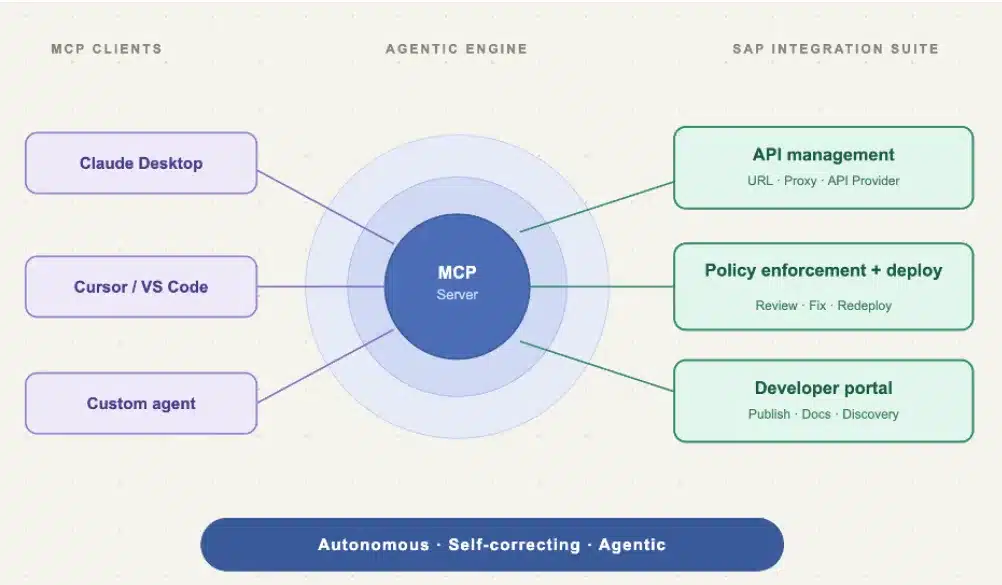
How Agentic AI Automates the SAP Integration Suite API Lifecycle
SAP Integration Suite already supports the complete API lifecycle. Our MCP Server hands over that lifecycle to an AI agent, enabling autonomous API management through natural language. A single instruction triggers an end-to-end workflow from API creation and policy configuration to deployment, documentation, and developer portal publication.
1. Intelligent API Creation
Based on the user’s intent, the AI determines whether to create:
- API as URL
- API as Proxy
- API with API Provider
It automatically configures backend endpoints, version management, and path mappings without requiring manual setup.
2. AI-Driven API Policy Generation
The agent analyzes the security and governance requirements and applies the appropriate combination of:
- Security policies
- Traffic management policies
- Mediation policies
- Extension policies
Instead of selecting policies manually, the AI builds the optimal configuration automatically.
3. Automated API Deployment
Once the API is configured, the agent:
- Creates the API proxy
- Applies the required policies
- Configures deployment targets
- Creates API Products
- Associates products with proxies
- Activates the runtime
If deployment encounters an issue, the agent diagnoses the error, updates the configuration, and retries automatically before completing deployment.
4. Developer Portal Publication
Publishing APIs is no longer a separate manual task.
The AI automatically publishes APIs to SAP API Business Hub, making them immediately discoverable by developers and consumers.
5. Automatic Documentation Generation
Comprehensive API documentation is generated directly from the API configuration, including:
- Endpoints
- Request and response schemas
- Authentication requirements
- Usage policies
The documentation is published alongside the API, ensuring consistency across every deployment.
6. Self-Correcting Validation
Before completing the workflow, the AI validates that:
- The API is active and reachable
- Policies are enforced correctly
- Responses match expectations
- Developer portal publication succeeded
If inconsistencies are detected, the AI resolves them autonomously before finalizing deployment.
Benefits of Agentic AI for SAP Integration Suite API Management
Organizations adopting this approach gain measurable advantages.
Accelerated API Delivery
Tasks that previously required hours of developer effort from API creation to documentation and publication are completed in minutes using natural language instructions.
2. Consistent Governance
Every API follows standardized naming conventions, policy enforcement, documentation, and publication processes, reducing configuration inconsistencies across projects.
3. Greater Scalability
Development teams spend less time on repetitive operational tasks and more time designing integration architecture and solving business challenges.
4. Self-Healing Operations
Rather than stopping when deployment errors occur, the AI identifies issues, applies corrective actions, and validates successful deployment automatically.
Security and Governance
Security remains a core design principle of the MCP Server.
The MCP Server authenticates connecting clients using Basic Authentication or OAuth 2.0 before exposing any available tools.
Importantly, business data does not pass through the AI conversation. Users provide operational intent, not transactional payloads or sensitive enterprise information.
SAP Integration Suite credentials remain securely stored within the MCP Server configuration and are never exposed during interactions with AI clients.
Additionally, every API created by the agent is protected using enterprise-grade security controls such as:
- OAuth 2.0
- API Key Verification
- JWT Validation
- IP Allowlisting
- Quota Enforcement
- Threat Protection
These are the same governance policies an experienced integration developer would configure manually, applied consistently across every API.

Frequently Asked Questions
1. What is Agentic AI in SAP Integration Suite?
Agentic AI enables SAP Integration Suite to autonomously execute API management tasks such as API creation, policy configuration, deployment, documentation, validation, and publication with minimal human intervention.
2. What is the Model Context Protocol (MCP)?
Model Context Protocol (MCP) is an open standard that enables AI models to interact securely with enterprise applications through standardized tool interfaces.
3. Can Agentic AI automate API deployment?
Yes. The MCP Server automates API creation, policy application, deployment, documentation, validation, and developer portal publication within SAP Integration Suite.
4. Does business data pass through the AI client?
No. Only user intent and configuration instructions are exchanged. Business transactions and sensitive payloads remain within enterprise systems.
5. Which AI clients are supported?
The MCP Server supports Claude Desktop, Cursor, VS Code Agents, and any MCP-compatible AI framework.
The Future of API Management is Autonomous
Agentic AI represents the next evolution of SAP Integration Suite API Management. By combining the Model Context Protocol with enterprise-grade API governance, organizations can automate repetitive tasks, improve consistency, accelerate API delivery, and enable autonomous API operations at scale.
If you’re exploring AI-powered API management for SAP Integration Suite, connect with our experts to learn how the MCP Server can transform your API lifecycle.
Interested in understanding more. Reach out
