













































B2B Integration – Pushing the Mapping Artifacts to SAP Cloud Platform Integration
WRITTEN BY
Hi Everyone!
This is my first blog post on Integration Content Advisor and I would like to share my learning experience on Integration Content Advisor.
In this blog post, I would be explaining the basic steps to be followed to create Message Implementation Guidelines (MIGs) and Mapping Guidelines (MAGs).
Introduction:
SAP Integration Advisor is a cloud application that helps to simplify and streamline the implementation flow of B2B/A2A and B2G integration process. It uses a crowd-based machine learning approach which helps to create integration content easily.
Integration Advisor solves the biggest problem that we face in B2B/A2A/B2G integration scenarios.
Pre-Requisites:
- Integration Content Advisor capability added to the Integration Suite.
- License for the Type Systems to create Message Implementation Guidelines(ASC_X12, UNEDIFACT,ETC)
The following steps explain the step-by-step procedure of creating MIGs and MAGs.
Creating Message Implementation Guideline(MIG):
STEP -1: Selecting the Type System to create source MIG:


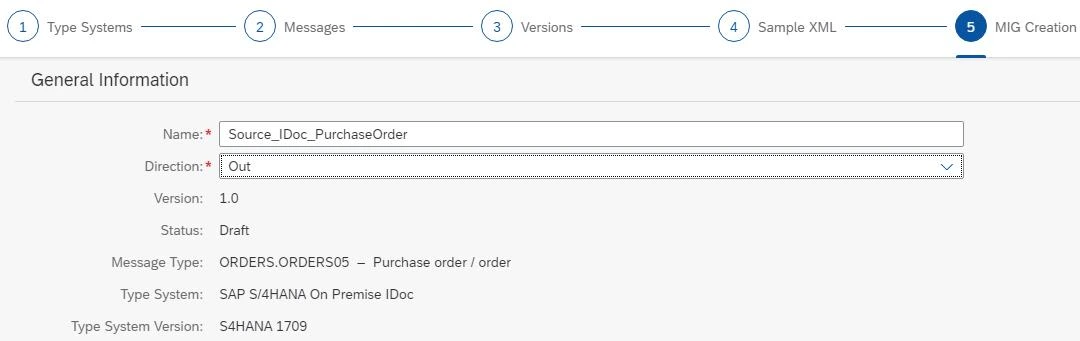
- In – The MIG describes a message that you receive from a Business Partner.
- Out – The MIG describes a message that you send to a Business Partner.
- Both – The MIG describes a message that can both be received from a partner or sent to a partner.
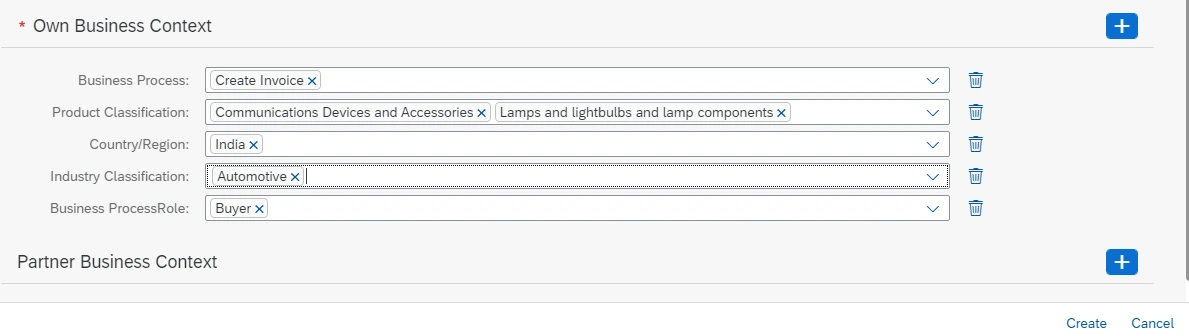
We can scroll through the definition proposal and decide which portions to accept, which to remove, and finally which additional fields or segments to enhance the Message Implementation Guideline definition with.
Now the MIG is created and saved in Draft mode with all the given details.
Once all done, save the MIG and Activate it.
Once you click on confirm, the MIG will be activated and stored in the Knowledge Graph and adds to the possible proposals for the next user (which maybe you!).
The changes that we make in the MIG will be saved as a New Version.
Follow all the above steps to create the Target Message Implementation Guideline by selecting Type System cXML and also the appropriate message type and version.
And ensure that the MIG is in “Active” state.
Creating Mapping Guidelines(MAG):
Here comes the important part!!!
In this step, we are creating the Mapping Guideline for the source and Target Message Implementation Guidelines.
Select the source and Target Message Implementation Guidelines to create Mapping Guidelines.


Save and Activate the Mapping Guideline (MAG).
EDI Integration Templates for SAP Integration Advisor:
One more amazing feature from SAP!!
In SAP Cloud Platform Integration, SAP provides the Integration flow templates for SAP Integration Advisor (IA) related to EDI integration scenarios.
And we can access the below integration package via the API Business Hub.
We can copy or download the entire the package to the Design part of the Cloud Integration to perform the B2B integration process.
Pushing the Runtime Artifact to SAP Cloud Integration:
1. By exporting the runtime artifacts, the Integration Advisor automatically generates number of schemas, scripts from a mapping guideline.
We can also export MIG and MAG as a documentation artifact, which is a PDF files which can be used as reference documentation for bookkeeping purposes.
2.In order to use the inject method; the destination has to be created in SAP BTP Subaccount.
In the next step, select the artifact template based on the Source and target Message type.


Our B2B integration scenario is ready to run with the communication Adapter configurations.
Conclusion:
This blog post explains a detailed step-by-step procedure to create the basic Message Implementation Guidelines, Mapping Guidelines and pushing the Runtime Artifact to the SAP Cloud Platform Integration.
Please do like the blog post, if you find the content helpful. Also, do share your inputs and opinions as comments.
Happy Learning!…
Reference Link:
https://blogs.sap.com/2021/09/28/integration-advisor-overview-of-components-for-building-b2b-integration-content-and-further-reading/
For more such informative technical articles on SAP Businness Technology Platform,
click here

How Does SAP Advanced Event Mesh Improve Real-Time Processing and Integration for Enterprises?
SAP Advanced Event Mesh (AEM) enables enterprises to build scalable, resilient, and real-time integration architectures across hybrid and multi-cloud environments. As part of the SAP Integration Suite, AEM supports event-driven architectures by decoupling applications and enabling seamless publish–subscribe communication. This ensures uninterrupted business processes, faster event distribution, and greater agility, even during system outages or maintenance empowering organizations to respond intelligently to modern digital demands.

How Can Consumer Products Brands Use SAP BTP to Build a Trusted Data Foundation for Faster Product Launches?
Consumer product companies face intense competition, evolving consumer expectations, demand for personalization, and sustainability goals. To stay ahead, brands must deliver innovative products faster with precision. This requires a unified data foundation connecting design, manufacturing, supply chain, and marketing. When data is siloed, decisions slow and inconsistencies grow. With SAP BTP, brands can centralize data, enhance accuracy, and drive agility, enabling faster, more confident decisions and accelerating innovation across the consumer products value chain.
